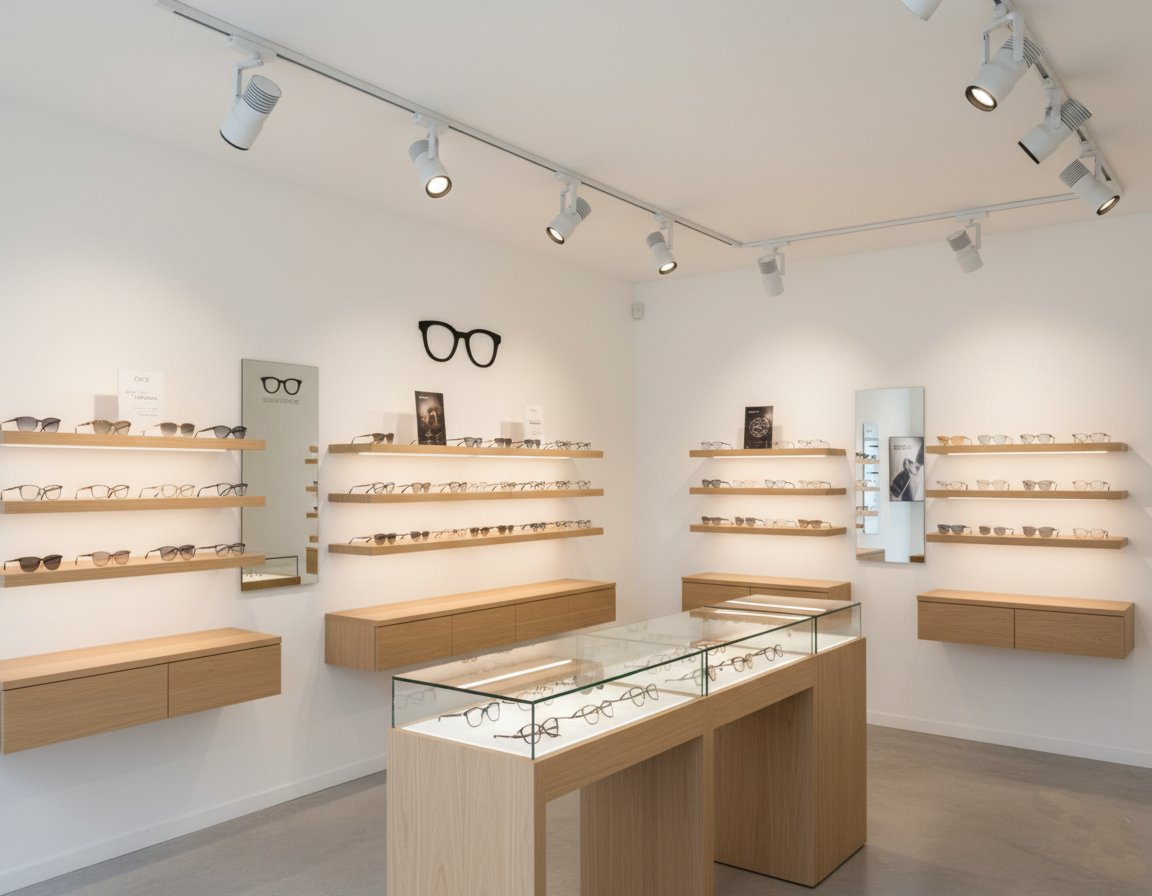
In a museum, light is not only a matter of visibility: it is a reagent. Every photon reaching a pigment, a fibre or an ink carries energy, and part of that energy breaks chemical bonds. The process is cumulative and irreversible: a faded watercolour never comes back. The right question is therefore not how bright is the room, but how much light has this object received since it went on display, and with which spectrum.
This page lines up the three figures that govern the matter — illuminance, dose and damage per lumen — and shows how to write them into a specification so that they can be verified rather than argued about.
1. How many lux: sensitivity categories
The limit does not depend on the room but on the material. CIE 157 (Control of damage to museum objects by optical radiation) classifies materials in four sensitivity categories, each with a maximum illuminance and a yearly exposure budget. The European standard EN 16163:2024 — Guidelines and procedures for choosing appropriate lighting for indoor exhibitions, published as BS EN 16163 in the United Kingdom — builds on the same approach and is the document to quote in a specification.
| Category | Materials | Max lux | Yearly dose (lx·h) |
|---|---|---|---|
| 1 — insensitive | stone, metal, ceramic, glass, enamel | no limit | no limit |
| 2 — low | oil and tempera, wood, ivory, bone, horn, fur | 200 | 600,000 |
| 3 — medium | textiles, watercolours, prints, drawings, dyed leather | 50 | 150,000 |
| 4 — high | silk, newsprint, fugitive dyes, some inks | 50 | 15,000 |
Categories 3 and 4 share the same illuminance limit but their yearly budgets differ by a factor of ten. Proof that the lux figure alone does not describe risk: it only describes the instant.
2. Dose: the figure that really counts
Dose is illuminance times exposure time, measured in lux hours. It is the running total a conservator has to keep, not the peak value.
A concrete case. A drawing displayed at 50 lux in a museum open 8 hours a day for 300 days:
- category 3 (budget 150,000 lx·h): inside, with little margin;
- category 4 (budget 15,000 lx·h): eight times over — that drawing can stay in the case some 37 days a year, not 300.
Hence the conservator's three levers, in order of effectiveness: cut the hours (rotation of originals, presence switching), cut the lux, and — the one almost nobody uses — change the spectrum at equal lux.
3. Damage per lumen: why spectrum changes everything
Not all wavelengths damage equally. Photon energy grows as wavelength shortens, and so does the ability to break bonds. CIE 157 formalises this with a damage function weighting each wavelength with a decreasing exponential:
Coefficient b depends on the material (0.0115 is commonly used for organic materials). The result: with that value 380 nm damages about seven times more than 550 nm; for the most sensitive materials, where b reaches 0.0195, the ratio rises to about twenty-eight. Weighting a luminaire's spectrum with this function and dividing by luminous flux gives damage per lumen in mW/lm — the figure that compares two different sources at equal perceived light.
What differs between LEDs
A conventional white LED is a 450 nm blue chip under a yellow phosphor: its spectrum has a narrow, very tall peak exactly where the damage function starts to bite, plus a cyan gap. A violet pumped LED (SunLike, Optisolis and similar) uses a chip around 405 nm with a broadband phosphor: the spectrum is nearly continuous, much closer to daylight, and the narrow blue spike disappears — the blue is still there, but spread out. Colour gains a lot: Ra above 95 and R9 above 80, so pigment reds look like themselves again.
What one often reads — that violet pumping also gives the lower damage per lumen — is not true, and the arithmetic says so. Weighting the spectra published by the chip makers with the CIE 157 function (b = 0.0115, 380-780 nm band) gives:
| Source | UV < 400 nm (µW/lm) | Damage per lumen (mW/lm) |
|---|---|---|
| violet pump 3000 K, Ra 96 | 4.5 | 0.208 |
| violet pump 4000 K, Ra 97 | 4.3 | 0.230 |
| blue pump 3000 K, Ra 92 | 0.8 | 0.159 |
| blue pump 4000 K, Ra 94 | 1.0 | 0.200 |
| halogen 3000 K (380-780 nm band only) | 40 | 0.225 |
Three things follow. First, violet pumping carries more ultraviolet — five or six times a common white LED — while staying almost an order of magnitude below halogen. Second, at equal colour temperature its damage per lumen is higher, by about thirty per cent: a continuous high-fidelity spectrum puts more energy in the violet-blue for every lumen it produces, and colour fidelity is paid for, a little, in damage. Third, and this matters more than the other two: the gap between the two chips is thirty per cent, the gap between 200 lux and 50 lux is three hundred. The project is won on dose and hours, not on the LED brand; the chip is chosen for colour, knowing what it costs.
Honestly: no source has zero damage. Visible light damages anyway. A better spectrum shifts the ratio between what is seen and what is consumed; it does not cancel it. The only way not to damage an object is not to light it.
4. Ultraviolet and infrared
UV. The usual line — “a LED emits no ultraviolet” — is a simplification and must not be used as a guarantee. Taken literally it holds for no white LED: even with a blue pump, chip at 450 nm, a tail remains below 400 nm — small, under 1 µW/lm on catalogue spectra, and larger on a cool white — but not zero. It is all the more false for the very high colour rendering violet pumped LEDs, whose chip sits at 405-415 nm, on the UV-A boundary, with a spectral tail running below 400 nm at 4-6 µW/lm. The emission stays low compared with an unfiltered halogen or a fluorescent source, which genuinely emit UV and need filters that age, but it is a quantity to be verified, not assumed to be zero.
The point is not to deny that tail but to measure it. The working parameter is the ultraviolet content in µW/lm, with the classic museum reference of 75 µW/lm at the object plane. On catalogue spectra a high-fidelity violet pumped LED sits between 4 and 6 µW/lm, a common white LED below 1, an unfiltered halogen above 40 in the 380-400 nm band alone: violet pumping is therefore well inside the reference, but it is not “UV free”, and whoever writes that in a catalogue is declaring a figure they do not have. For category 4 materials a 400 nm cut-off filter is added — on our own calculation it takes the ultraviolet from 4.5 to 1.0 µW/lm while leaving colour rendering where it was — or a blue pump is chosen instead: a design decision, not a declaration. With one caveat stated in full: the filter removes the ultraviolet, not the damage, because damage per lumen is almost entirely made by visible light.
IR. Infrared does not fade, it heats: it creates thermal gradients and relative humidity cycles inside the case, which on wood, ivory, parchment and panel paintings produce cracks and lifting. A LED radiates little IR towards the object, but heat exists and leaves through the heat sink: inside a sealed case the problem is not radiation, it is the luminaire warming the air. This is why keeping the driver outside the case and controlling internal temperature matter as much as the spectrum.
5. Colour: CRI is not enough
| Index | What it measures | Limitation | Useful museum value |
|---|---|---|---|
| Ra (CRI) | average over 8 pastel colours | ignores saturated ones | > 95 |
| R9 | saturated red | not part of Ra average | > 90 |
| R12 | saturated blue | often the lowest | > 70 |
| Rf (TM-30) | fidelity over 99 samples | — | > 90 |
| Rg (TM-30) | average saturation | — | 98 – 102 |
Ra 90 with R9 near zero is perfectly possible and typical of cheap LEDs: the average stays high because the eight samples are pastel, while lake red, purple and skin tones go dull. In an art museum that is a serious defect, because it misrepresents the work. Serious verification is therefore run on real pigments — spectral reflectance libraries of historical pigments allow the ΔE between the source and the reference to be computed.
Colour temperature
The museum de facto standard is 3000 K, with 2700 K for historic interiors and reconstructed flame sources. Above 4000 K the blue content grows and so does damage per lumen. This is no detail: taking one and the same chip in its two versions, the cool white around 6000 K reaches about 60% more damage per lumen than the 3000 K version, and on the cool white the 420-480 nm band alone carries almost 60% of the total damage. Colour temperature therefore weighs more than the type of pump: cool white in a museum is justified only on insensitive materials.
6. Verification on site
- Illuminance on the object plane, not on the floor: lux meter on the brightest point of the displayed surface.
- Uniformity inside the case: the min/max ratio tells whether one spot accumulates dose much faster than the rest.
- Measured spectrum of the installed luminaire, not of the datasheet: case glass, filters and depreciation change the result.
- Operating hours logged, not estimated. It multiplies everything else and is the only factor that can be changed without touching the display.
- Temperature and humidity inside the case, correlated with switching.
7. What to write in a specification
Museum tenders are won on the technical offer, often with 70/30 criteria. A requirement written as "high quality LED lighting with excellent colour rendering" is not verifiable and awards points to nobody. Working clauses are numerical:
- measured spectrum attached in numerical form (wavelength / relative irradiance), step ≤ 5 nm;
- damage per lumen declared according to CIE 157, stating the b coefficient used;
- Ra ≥ 95, R9 ≥ 90, colour tolerance within 3 SDCM;
- ultraviolet content below 400 nm declared in µW/lm at the object plane (reference ≤ 75 µW/lm) and irradiance beyond 700 nm declared in mW/lm;
- maximum illuminance per material category to CIE 157 / EN 16163;
- yearly dose budget in lx·h and a method for recording exposure;
- dimming from 1 % to 100 % with no colour temperature shift;
- declared heat dissipated inside the showcase.
8. Frequently asked questions
It depends on the sensitivity of the material, not on the type of room. The four CIE 157 categories range from no limit for stone, metal, ceramic and glass to 50 lux for silk, newsprint and fugitive dyes, with 200 lux for oils, tempera and wood and 50 lux for textiles, watercolours, prints and dyed leather. The lux limit alone is not enough: the yearly dose is what counts.
The dose is illuminance multiplied by exposure time, measured in lux hours. An object lit at 50 lux for eight hours a day, three hundred days a year, receives 50 x 8 x 300 = 120,000 lux hours per year. That is still within the 150,000 lux hours allowed for CIE 157 category 3, but eight times over the 15,000 allowed for category 4.
Because damage does not depend on lux but on the spectrum. The CIE 157 damage function weights each wavelength with an exponential rising towards violet and ultraviolet: the same amount of visible light, if rich in blue and violet, produces more damage. The figure that tells them apart is damage per lumen, in milliwatts per lumen.
The right question is not whether it emits ultraviolet or not: the sentence "a LED emits no ultraviolet" is inaccurate and should never be used as a guarantee. No white LED emits zero below 400 nm: the one with a 450 nm blue pump stays under 1 microwatt per lumen on catalogue spectra, little but not nothing, and in exchange it concentrates the dominant peak of the whole spectrum at 450 nm; a very high colour rendering LED with a violet pump at 405-415 nm peaks at the edge of the ultraviolet and has a tail below 400 nm, but over a very small fraction of the power, because nearly all the light is re-emitted by the broadband phosphor. The comparison is made on the integral: the CIE 157 damage function is exp(-b(lambda-300)) with b between 0.0115 and 0.0195 per nanometre, so one watt at 405 nm weighs 1.7 to 2.4 times one watt at 450 nm, not a thousand times. Weighting the spectra published by the chip makers over 380-780 nm with b = 0.0115 gives, at equal colour temperature, about 4.5 microwatts per lumen below 400 nm for the violet pump against 0.8 for a common white LED and about 40 for an unfiltered halogen, and a damage per lumen of 0.208 against 0.159 milliwatts per lumen: violet pumping therefore carries more ultraviolet and about thirty per cent more damage per lumen, in exchange for Ra 96 and R9 above 80. These are catalogue spectra, not measurements of the finished luminaire. The gap between chips is thirty per cent, while between 200 and 50 lux it is three hundred: the project is decided on dose and hours. What should be required is the damage per lumen computed on the measured spectrum of the luminaire and the ultraviolet content in microwatts per lumen, whose classic museum reference is 75 microwatts per lumen; for the most sensitive materials a 400 nm cut-off filter is added, or a blue pump is chosen instead.
CRI, or Ra, is an average over eight pastel colours and says almost nothing about saturated reds. R9 is the saturated red index, where cheap LEDs collapse: a luminaire can show Ra 90 and an R9 close to zero, and in that case skin tones and lake reds look dull. Rf and Rg of the TM-30 system measure average fidelity and average saturation over 99 samples and are far more reliable. For museum use, ask for Ra above 95 and R9 above 90.
Verifiable requirements, not adjectives. Measured spectrum attached in numerical form, damage per lumen declared according to CIE 157, minimum Ra and R9, ultraviolet content below 400 nm declared in microwatts per lumen at the object plane and irradiance beyond 700 nm declared in milliwatts per lumen, maximum illuminance per material category, yearly dose budget in lux hours and a method for recording exposure. Then comparing offers becomes a technical exercise, not only a price one.
9. From the standard to the project
Put together, those figures show that keeping an object below the limit is not a matter of power but of three choices in sequence: the spectrum, which sets how much damage each lumen carries; the beam, which sets where those lumens land — a beam shaped on the object avoids spending dose on the back and edges of the case; and the logging, which turns the budget from a forecast into data. Written as performance clauses, these are also the three items that make offers comparable in a technically weighted tender.
How we do it
Spectrum, beam and logging are not three accessories: they are the three points a luminaire is judged on. ACSE covers them with three parts that work together.
SKILL — Dose stops being an estimate.
Illuminance probe inside the case, non volatile memory and data download: lux, operating hours and accumulated dose in lx·h are logged. The yearly budget becomes a document that can be attached to a conservation report, not a forecast.
Free Form optics — Lumens land on the object, not around it.
The reflector is computed on the perimeter to be lit. Light that is not needed is never emitted: at equal lux on the object, less dose is spent on the back and edges of the case, so staying within budget does not mean dimming the display.
Spectrum selected LED chips — The figure is declared, not promised.
The LED is not taken off the shelf: it is chosen on its spectrum. Violet pumping at ~405 nm with broadband phosphor, no narrow 450 nm blue peak, Ra > 95 and R9 > 90, tight colour temperature binning. The spectrum of the delivered luminaire is declared, not promised, and with it the two figures that matter: damage per lumen to CIE 157 and the content below 400 nm in microwatts per lumen — museum reference 75 µW/lm, violet pumping sitting around 4-6. We also state the other side, because that is how one works with a conservator: that colour fidelity costs about thirty per cent more damage per lumen than a blue pumped chip, and for category 4 materials a 400 nm cut-off filter is fitted or a blue pump is chosen. This is not a single model: the selection applies to almost the whole range, from the case spotlight to the track projector.